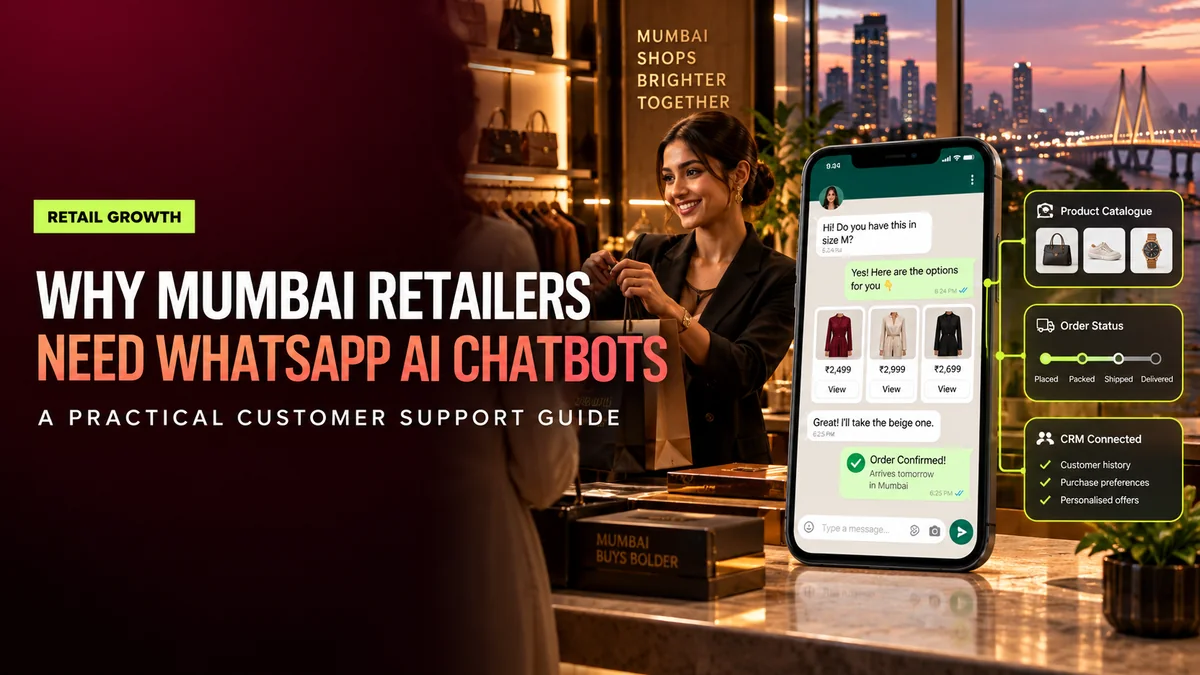
Why Mumbai Retailers Need WhatsApp AI Chatbots
Mumbai retailers already meet customers where they are: on WhatsApp. Shoppers ask about sizes, colours, stock, delivery, customisation, returns, and offers in short messages, voice notes, and images. When every conversation depends on one busy team member, a good lead can wait too long and a repeat customer may not receive a consistent answer.
A WhatsApp AI chatbot can handle the first layer of routine conversations while keeping the sales and support team in control. The value is not just an automated reply. It is the connection between the customer message, product or order data, CRM ownership, and the next human action.
Why WhatsApp is a high-value retail channel in Mumbai
A retail customer often starts with a simple question and decides quickly whether to continue. If the team has to search a catalogue, check availability, find a delivery policy, and then remember to follow up, response quality depends on workload. A guided chatbot can collect the product, size, location, budget, and urgency before assigning the conversation.
Mumbai retailers also serve different neighbourhoods, delivery zones, and customer preferences. A workflow can record the location and preferred channel, show only approved information, and route high-value or complex requests to a person. This makes the customer journey faster without making it impersonal.
Retail conversations a WhatsApp AI chatbot can handle
The assistant can share a product catalogue, answer material or size questions, collect a store-visit request, explain delivery timelines, check an order status, and create a support ticket. For a furniture or home brand, it can ask about room size, style, budget, and delivery location before a design consultant calls.
For repeat purchases, the chatbot can identify the customer, show approved recommendations, share a reorder path, and send a reminder after a human-approved interaction. It should not invent stock, price, delivery dates, or policies. Those answers should come from a maintained source of truth.
- Product discovery and catalogue sharing
- Store visits, callbacks, and quotation requests
- Order, delivery, return, and exchange questions
- Lead qualification and CRM record creation
- Human escalation for complaints and high-value sales
Connect WhatsApp with ecommerce and CRM data
A chatbot becomes more useful when it can do something reliable after the conversation. A website form, ecommerce order, CRM lead, and support ticket should not become four separate records. The integration should define identity matching, consent, field ownership, and what happens when a system is unavailable.
A production workflow also needs logs and retries. If an order lookup fails, the assistant should explain that it is checking and create a human task rather than making up a status. If a customer wants to speak to someone, the team should receive the summary and relevant context so the conversation does not restart from zero.
Design for Mumbai customers and real conversations
Customers may switch between English, Hindi, Hinglish, abbreviations, voice notes, and local product language. Test the flow with real message styles, spelling variations, images, incomplete questions, and customers who change their requirement mid-conversation. The tone should be clear and helpful rather than overly robotic.
The chatbot should make its boundaries visible. A customer needs an easy route to a person, especially for payment concerns, complaints, returns, custom orders, or delivery exceptions. Good automation reduces waiting while preserving trust and responsibility.
Measure retail chatbot performance
Track time to first response, qualified enquiries, catalogue engagement, store-visit requests, quotation completion, support resolution, handoff rate, and missed conversations. Compare these numbers with the old process instead of assuming that more messages mean better performance.
Also review failed intents every week. The questions the chatbot cannot answer reveal missing product data, unclear policies, or opportunities to improve the website and staff training. A Mumbai retail chatbot should become more useful through this feedback loop.
Frequently Asked Questions
What can a WhatsApp AI chatbot do for a Mumbai retailer?
It can answer approved product questions, share catalogues, qualify leads, request store visits, check order status, collect support details, create CRM records, and transfer complex conversations to a person.
Can a WhatsApp chatbot connect with ecommerce orders?
Yes. It can connect to an ecommerce or order system through approved APIs or webhooks. The flow should use live data, define permissions, handle failures, and avoid exposing information to the wrong customer.
Will customers know they are talking to AI?
The experience should be transparent and make human support easy to reach. Clear language, a visible handoff option, and accurate answers build more trust than pretending the assistant is a person.
Can the chatbot understand Hindi and Hinglish?
It can, but quality depends on the messaging platform, model, knowledge base, and testing. Use real customer phrases, local product terms, voice notes, and spelling variations before launch.
How can a Mumbai retailer start with WhatsApp automation?
Start with one high-volume use case such as product enquiries, order updates, or lead qualification. Define the source of truth, human handoff, success metrics, and a pilot before expanding to every customer journey.
Need help turning a repetitive workflow into a reliable system? Talk to Autozentic about AI automation, CRM software, custom software, ecommerce, voice agents, or branding for your business.