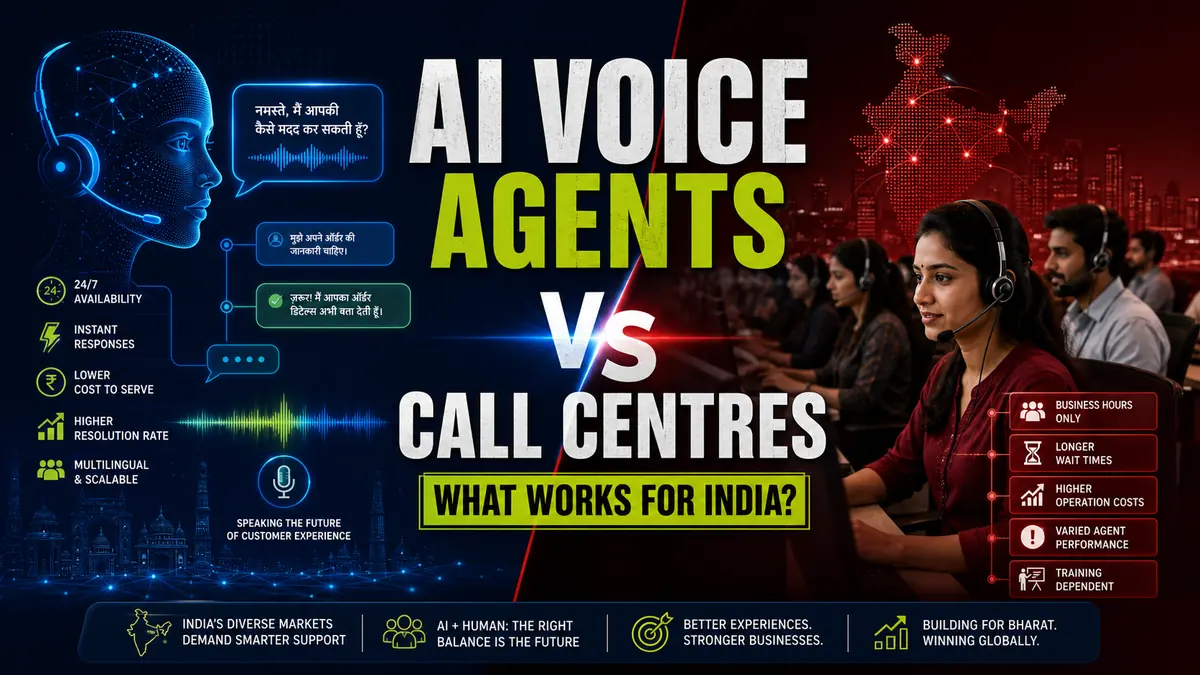
AI Voice Agents vs Traditional Call Centres in India
Indian businesses often have a simple support problem: customers want an immediate answer, but a small team cannot answer every call at every hour. Traditional call centres solve this with people, schedules, scripts, and supervisors. AI voice agents solve a different part of the same problem with software that can listen, reason within defined boundaries, and take action.
The right choice is rarely a simple “AI versus humans” decision. For many businesses, the strongest model is an AI first line for routine calls and a trained human team for exceptions, high-value sales, negotiations, and sensitive conversations.
Availability and response time
A call-centre team works in shifts and must balance staffing with demand. During campaigns, weekends, festivals, or unexpected spikes, callers may wait or abandon the call. An AI voice agent can answer multiple calls concurrently and stay available outside normal office hours, subject to the telephony and hosting setup.
This advantage matters for lead capture. A lead generated by an advertisement may call when the sales team is busy. An agent can collect the requirement, share approved information, and book a callback so that the opportunity is not lost before a person becomes available.
Conversation quality and human judgement
Human agents are better at nuanced conversations, negotiation, empathy, and unusual requests. They can read emotional context and make judgement calls that should not be delegated to a model. AI voice agents are strongest when the intent is known, the knowledge is controlled, and the next action is clear.
A production voice system should therefore have confidence thresholds and a fast human handoff. It should tell the caller when a person is joining, pass along the transcript or summary, and avoid asking the customer to repeat everything. This combined workflow is more practical than expecting a bot to handle every call type.
Cost and operating model
A traditional call centre has recurring people costs, hiring and training costs, supervisor overhead, facilities, and the cost of missed calls when demand exceeds capacity. An AI agent has development and integration costs, plus usage-based telephony, model, hosting, and maintenance costs.
The comparison should use the business baseline rather than a generic per-agent claim. Calculate call volume, average handling time, repeat queries, after-hours demand, and the value of a qualified lead. If the agent handles routine work and gives staff better context, the business can evaluate both direct savings and capacity created for the existing team.
Languages, accents, and Indian workflows
Indian callers may switch between Hindi, English, Hinglish, and regional expressions in one conversation. Voice AI must be tested with real accents, background noise, names, addresses, product terms, and numbers. A polished English demo is not enough evidence that the system will work for customers in Jaipur or elsewhere in Rajasthan.
The agent should also understand local business context such as delivery areas, showroom timings, appointment slots, payment steps, and escalation rules. These details belong in a maintained knowledge base and integration layer, not in a one-time prompt that nobody reviews.
When to choose a hybrid model
A hybrid model is a good fit when the business has a high volume of repetitive calls but still needs people for closing, complaints, or sensitive cases. AI can handle greeting, intent detection, basic qualification, order lookup, reminders, and summaries. Humans can take over when the customer asks for a manager, the intent is uncertain, or a policy exception is required.
Start with one call type, record failure modes, and improve the flow before adding outbound campaigns or additional languages. Autozentic builds production-level voice and automation systems with integrations and handoff paths designed around the client workflow.
Frequently Asked Questions
Are AI voice agents better than call-centre employees?
They are better for availability, repetitive conversations, concurrent calls, and consistent workflows. Human agents remain better for empathy, negotiation, complex complaints, and judgement. Many Indian businesses benefit from a hybrid model.
Can an AI voice agent transfer a call to a human?
Yes. The transfer can be triggered by a request for a person, low confidence, a sensitive topic, or a defined business rule. The system should pass the conversation context to the human team.
Do AI voice agents understand Hindi and Hinglish?
They can, but performance depends on the speech and language stack, prompt design, audio quality, and testing with real callers. Hindi, Hinglish, names, numbers, and local terms should be evaluated before launch.
Are AI voice agents suitable for sales calls in India?
They can qualify leads, answer approved questions, schedule meetings, and run structured follow-ups. High-value negotiation and final closing are usually better handled by a trained salesperson.
What should I compare when selecting a voice AI provider?
Compare real-call accuracy, integrations, human handoff, logging, security, multilingual testing, telephony reliability, ongoing support, and the clarity of usage and maintenance pricing.
Need help turning a repetitive workflow into a reliable system? Talk to Autozentic about AI automation, CRM software, custom software, ecommerce, voice agents, or branding for your business.