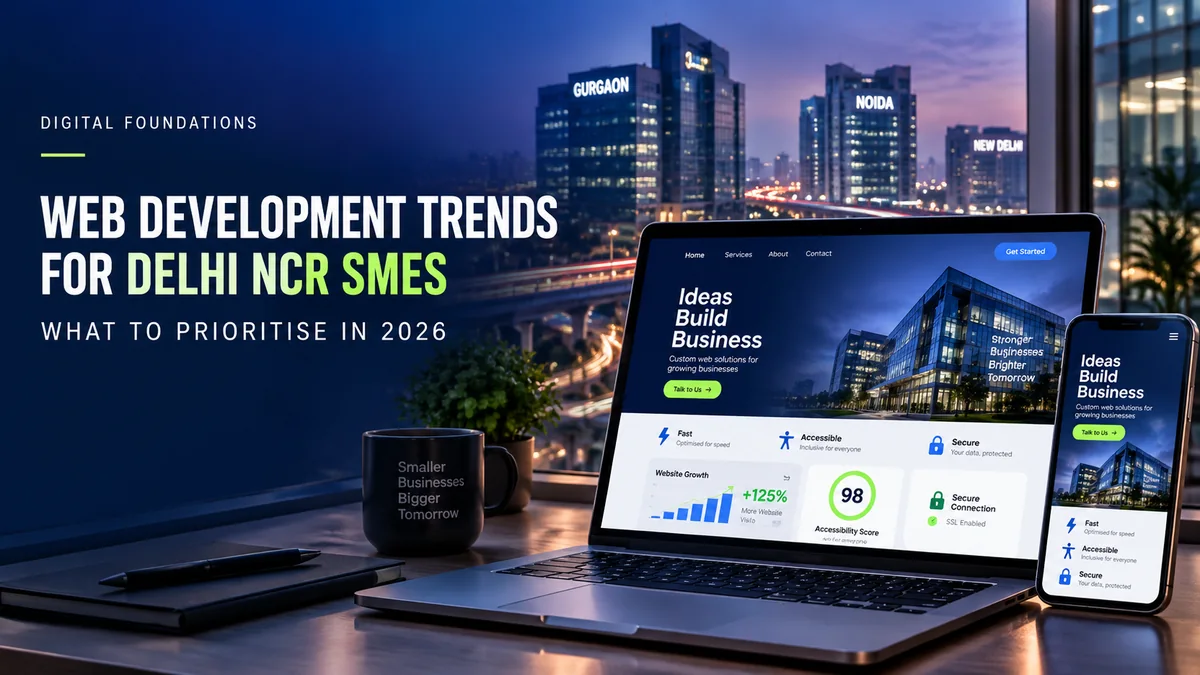
Web Development Trends for Delhi NCR SMEs: What to Prioritise in 2026
For a Delhi NCR SME, a website is often the first place a customer checks credibility, services, pricing context, location, and the next step. A modern website is not defined by animation alone. It should load quickly on a mobile connection, explain the offer, support accessibility, protect customer data, and connect enquiries to the team that will respond.
In 2026, the strongest web development decisions are practical. Performance, conversion clarity, structured content, secure integrations, and maintainable software create a better foundation than adding features because they are fashionable. This guide helps Delhi NCR businesses decide what to prioritise.
Prioritise mobile performance and Core Web Vitals
Customers often open a website from a search result, social post, message, or advertisement on a mobile device. Large hero media, unnecessary JavaScript, layout shifts, and slow third-party scripts can make a good offer feel unreliable. Optimised images, responsive layouts, lazy loading, sensible font loading, and a stable page structure should be part of the build from the beginning.
Performance work should be measured on representative mobile connections, not only on a developer laptop. Track the largest content element, layout stability, interaction readiness, and the real pages that generate enquiries. A fast page also gives search engines and users a clearer experience.
Build conversion paths for how Delhi NCR customers decide
An SME website may serve customers in Gurgaon, Noida, Delhi, Faridabad, Ghaziabad, or beyond. Location, service area, availability, delivery, and response expectations should be easy to understand. Each important page needs a clear next step: call, WhatsApp, enquiry form, book a visit, request a quote, or view a relevant case study.
Avoid making every visitor solve the same problem. A buyer who needs a quick service request should not have to read a long company story first. Clear page hierarchy, useful proof, FAQs, and concise forms can improve qualified enquiries without changing the visual identity of the business.
Use accessible, secure, and maintainable foundations
Accessibility is part of professional web development. Semantic headings, readable colour contrast, keyboard navigation, meaningful labels, descriptive image alternatives, and useful error messages help more people use the website. These choices also make the content easier for search engines to understand.
Security and maintenance deserve the same attention. Keep dependencies updated, protect forms, limit access to admin tools, validate submissions, manage secrets safely, and define backup and recovery expectations. A secure website is easier to trust and less expensive to repair after a preventable incident.
Connect the website to CRM and AI where it creates value
A form submission should not disappear into an inbox. Where appropriate, connect it to a CRM, assign ownership, send an acknowledgement, and create a follow-up task. AI can help classify an enquiry, summarise a long message, suggest a next action, or answer approved questions—but the team should retain control over pricing, commitments, and sensitive decisions.
For larger teams, a custom portal or dashboard may be more useful than adding another plugin. The right choice depends on workflow, data, permissions, integrations, and the cost of manual work. Start with one measurable problem and keep the architecture ready for future growth.
A 2026 website roadmap for Delhi NCR SMEs
Begin with a content and conversion audit: which pages attract visitors, which questions stop them, where enquiries are lost, and which tools the team already uses. Then prioritise performance and mobile usability, clarify the main service pages, improve forms and tracking, and connect the first workflow to the CRM or support process.
After launch, review search queries, page engagement, form quality, response time, and sales outcomes. A website should improve through evidence. This creates a durable digital foundation for a Delhi NCR business instead of a redesign that becomes outdated as soon as it goes live.
Frequently Asked Questions
What are the most important web development priorities for a Delhi NCR SME?
Start with mobile performance, clear service pages, conversion paths, accessibility, security, structured SEO content, and reliable enquiry handling. Add advanced features only when they solve a measurable business problem.
How can a Delhi business improve website leads?
Clarify the offer, add relevant proof and FAQs, reduce form friction, make contact options visible, improve mobile speed, connect forms to a CRM, and measure qualified enquiries rather than only traffic.
Should an SME use WordPress, Shopify, or custom development?
The right choice depends on content, ecommerce complexity, integrations, permissions, performance needs, and long-term ownership. A platform is useful when it fits the workflow; custom development is useful when the business needs a unique or deeply connected system.
Can AI be added to an existing Delhi NCR business website?
Yes. AI can support approved FAQs, lead qualification, summaries, search, or CRM workflows. It should use controlled knowledge, clear boundaries, a human fallback, and testing with real customer questions.
How often should an SME review its website?
Review performance, content, forms, accessibility, security, and search data at least quarterly. High-value pages should be improved when the data shows confusing queries, low engagement, slow loading, or poor-quality enquiries.
Need help turning a repetitive workflow into a reliable system? Talk to Autozentic about AI automation, CRM software, custom software, ecommerce, voice agents, or branding for your business.