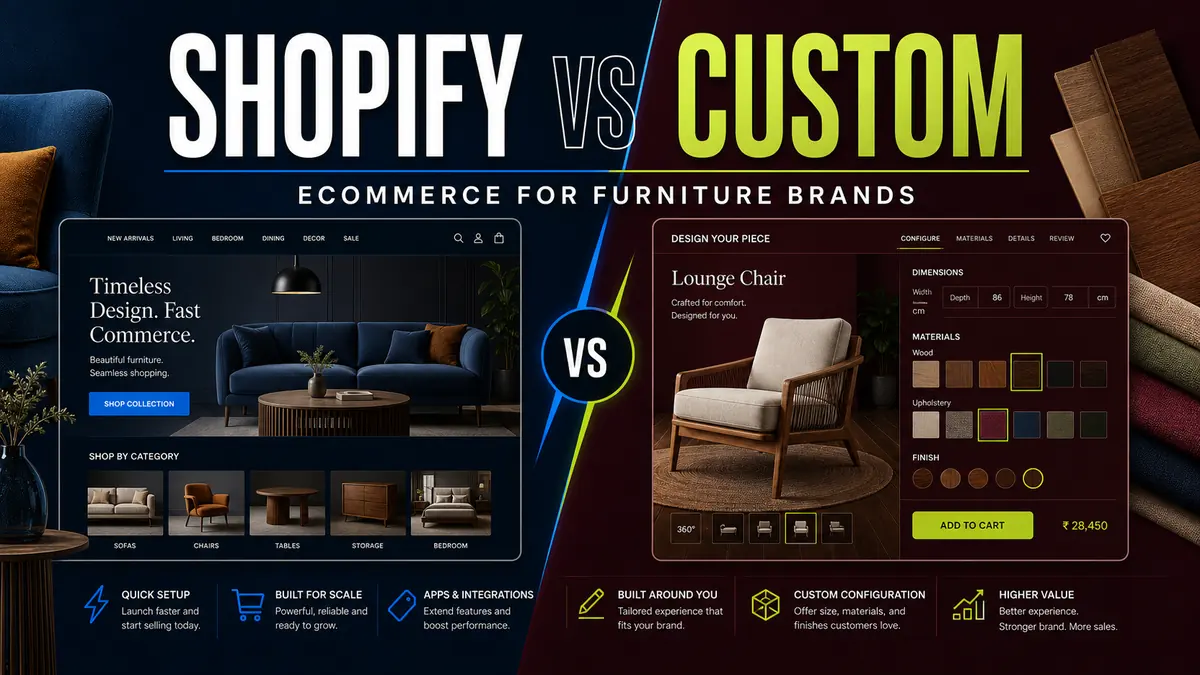
Shopify vs Custom Ecommerce for Furniture Brands
Furniture ecommerce is different from selling a small set of identical products. Customers may want different dimensions, materials, finishes, fabrics, delivery areas, installation options, and custom quotations. Many products are high-consideration purchases where a website needs to support both online conversion and showroom conversation.
Shopify can help a furniture brand launch quickly with reliable commerce foundations. A custom ecommerce system can fit unusual product and operational workflows more closely. The right decision depends on how much of the sale can be standardised and where the brand needs control.
Where Shopify is strong
Shopify provides a mature foundation for catalogues, checkout, payments, orders, themes, apps, and basic analytics. It can be a good fit for a furniture brand with standard products, clear pricing, manageable variants, and a desire to launch or test demand quickly.
The platform also reduces the operational burden of building commerce basics from scratch. The team can invest more in product photography, merchandising, content, campaigns, and customer support while using established tools for the store core.
- Faster route to a working online store
- Established checkout and payment ecosystem
- Themes and apps for common requirements
- Useful for testing a focused catalogue or collection
Where custom ecommerce is stronger
Custom ecommerce is valuable when product configuration, quotations, showroom appointments, regional delivery, production status, or dealer workflows are central to the business. The system can be designed around the real journey instead of forcing every product into a standard variant model.
A custom build can connect the storefront more deeply with CRM, inventory, manufacturing, delivery, or an internal product catalogue. It offers control over the experience and roadmap, but the business also owns more responsibility for reliability, security, maintenance, and future development.
Furniture-specific questions to answer
Can the customer configure size, fabric, finish, and add-ons without confusion? Can the business show an estimated price or request a quote? Can delivery cost and availability vary by pincode? Can showroom staff see the same enquiry and product context? Can the catalogue support products that are made to order?
Answer these questions before choosing the platform. A technically simple product page may hide a complex quotation and fulfilment process. If the workflow is not designed, the customer and sales team will fill the gaps with calls and spreadsheets.
Total cost and ownership
Shopify cost includes subscription, theme or customisation, apps, payment fees, integrations, and ongoing content. Custom ecommerce cost includes discovery, design, engineering, infrastructure, maintenance, security, and integrations. Compare both over at least three years and include the internal work needed to operate them.
Also review ownership. The business should control its domain, analytics, customer data, product content, vendor accounts, and access to integrations. A platform decision should not create avoidable lock-in around basic business information.
A sensible path for many furniture brands
A staged approach often works: launch a focused Shopify catalogue to validate demand, while documenting the custom workflows that create friction. If the business proves that product configuration, showroom conversion, or operations need deeper control, build a focused custom layer or migrate with evidence.
For brands with an already complex workflow, starting with discovery and a custom commerce architecture may be more efficient. Autozentic can help furniture businesses connect ecommerce, CRM, automation, and brand experience around the way they actually sell.
Frequently Asked Questions
Is Shopify good for a furniture brand?
Yes, especially when the catalogue, pricing, variants, checkout, and delivery rules are relatively standard. It can help a brand launch quickly while focusing on merchandising and demand generation.
When does a furniture brand need custom ecommerce?
Custom ecommerce is more suitable when the business needs complex product configuration, custom quotations, showroom workflows, regional delivery logic, production integration, or a highly distinctive customer journey.
Can Shopify connect with a furniture CRM?
Yes. Shopify can connect through supported apps, APIs, and webhooks. Define the customer, product, order, enquiry, and inventory data flows so that duplicate or conflicting records are avoided.
Which option is cheaper: Shopify or custom ecommerce?
Shopify usually has a lower initial build cost, while custom ecommerce can be more economical for a distinctive workflow over time if it replaces manual work and multiple disconnected tools. Compare total cost of ownership, not only launch price.
Can a furniture ecommerce site support showroom enquiries?
Yes. Product pages can offer consultation, measurement, callback, WhatsApp, or showroom appointment actions alongside direct checkout. The enquiry should enter a CRM workflow with clear ownership and follow-up.
Need help turning a repetitive workflow into a reliable system? Talk to Autozentic about AI automation, CRM software, custom software, ecommerce, voice agents, or branding for your business.