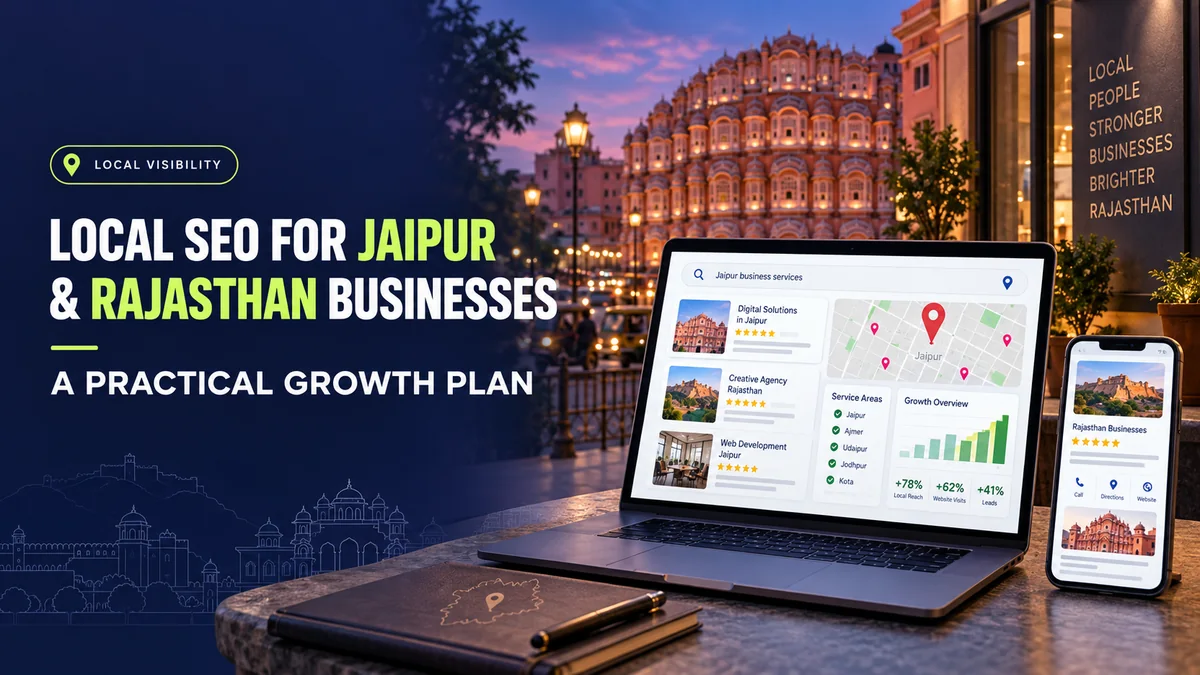
Local SEO for Jaipur and Rajasthan Businesses: A Practical Growth Plan
Local SEO is not just adding a city name to a page. A Jaipur customer wants to know what a business does, whether it understands the local market, what areas it serves, how to contact it, and why it should be trusted. Search engines need the same clarity through useful content, consistent technical signals, and a crawlable site structure.
This plan is designed for businesses in Jaipur and across Rajasthan that want to build durable visibility before expanding into cities such as Delhi NCR and Mumbai. It focuses on pages and processes the business can control: service content, location pages, internal links, structured data, technical SEO, reviews, and measurement.
Start with search intent, not a list of keywords
A person searching for an AI automation company in Jaipur has a different need from someone searching for CRM software for a furniture business or an ecommerce website developer in Rajasthan. Map the customer’s problem, service, location, and next decision before writing a page. This creates content that answers questions rather than repeating phrases.
Use one primary intent for each important page and support it with related questions. A service page should explain the service and proof. A city page should explain how the service applies to businesses in that area. A blog post can answer an educational question and link the reader to the right service or contact path.
Build useful service-area and city pages
Jaipur deserves a location page that reflects the local business context and the company’s real presence. Service-area pages for Jodhpur, Delhi NCR, Mumbai, and Bangalore should be genuinely distinct: different industries, workflows, examples, expectations, and implementation considerations. A city name swap creates thin content and weakens trust.
Each page should have one clear H1, logical H2 sections, a useful introduction, FAQs, internal links, a clear contact path, and accurate service-area language. Avoid claiming a local office or client result that does not exist. Explain how the business works remotely or across regions when that is the truth.
Strengthen technical and on-page SEO
Every indexable page needs a useful title, meta description, canonical URL, one clear H1, structured headings, descriptive image alternatives, and a stable URL. Make sure the XML sitemap contains important pages, the robots rules do not block render-critical assets, and broken internal links are removed.
Performance is part of the search experience. Resize and compress images, use modern formats, defer non-critical work, reduce layout shifts, and test important pages on mobile. The goal is not a perfect score in isolation; it is a fast, readable, reliable experience for the people who arrive from search.
Use internal links and structured data with purpose
Internal links help users move from a question to a solution. A blog post about AI automation in Jaipur can link to the AI automation service, a CRM case study, a location page, and the contact page where relevant. Use descriptive anchor text and link only when the destination genuinely helps.
Structured data can clarify the organisation, local business, service, article, breadcrumbs, and FAQs. It does not guarantee rankings, but it gives search engines a consistent way to understand the page. Keep the markup accurate and aligned with content visible to users.
Measure local SEO with business outcomes
Track impressions, clicks, search queries, landing pages, city-level traffic, qualified form submissions, calls, and assisted conversions. A page with fewer visits but strong enquiries may be more valuable than a page that attracts broad, unqualified traffic. Use the data to improve titles, introductions, FAQs, and calls to action.
Review important pages quarterly. Update years, pricing context, service details, examples, screenshots, and links when the business changes. Local visibility compounds when the site stays accurate, useful, technically sound, and connected to the customer journey.
Frequently Asked Questions
How can a Jaipur business improve local SEO?
Create useful service and location pages, use accurate titles and structured headings, improve mobile performance, add internal links, keep contact information consistent, publish helpful local content, and measure qualified enquiries from search.
Should a Rajasthan business create a page for every city?
Only create pages for cities the business genuinely serves and can discuss usefully. Each page should have unique local context, service relevance, and a truthful delivery model rather than copied text with a new city name.
Do blog posts help local SEO in Jaipur?
They can help when they answer real questions from Jaipur or Rajasthan customers and link naturally to relevant services and location pages. Blog posts should support the business journey, not exist only to repeat keywords.
What technical SEO basics should a local website have?
Use HTTPS, stable canonical URLs, crawlable pages, accurate metadata, a clean sitemap, fast mobile pages, descriptive image alternatives, structured headings, working internal links, and a useful 404 experience.
How long does local SEO take to show results?
Timing depends on competition, authority, content quality, technical health, and demand. Track progress over several months using impressions, rankings, clicks, qualified enquiries, and conversions rather than expecting an immediate result from one page.
Need help turning a repetitive workflow into a reliable system? Talk to Autozentic about AI automation, CRM software, custom software, ecommerce, voice agents, or branding for your business.