How to Choose an AI Automation Company in India
Choosing an AI automation company in India is not the same as choosing a vendor for a simple website. The partner may influence customer communication, business data, sales follow-up, support quality, and operational decisions. A flashy demo is not enough evidence that a system will work in production.
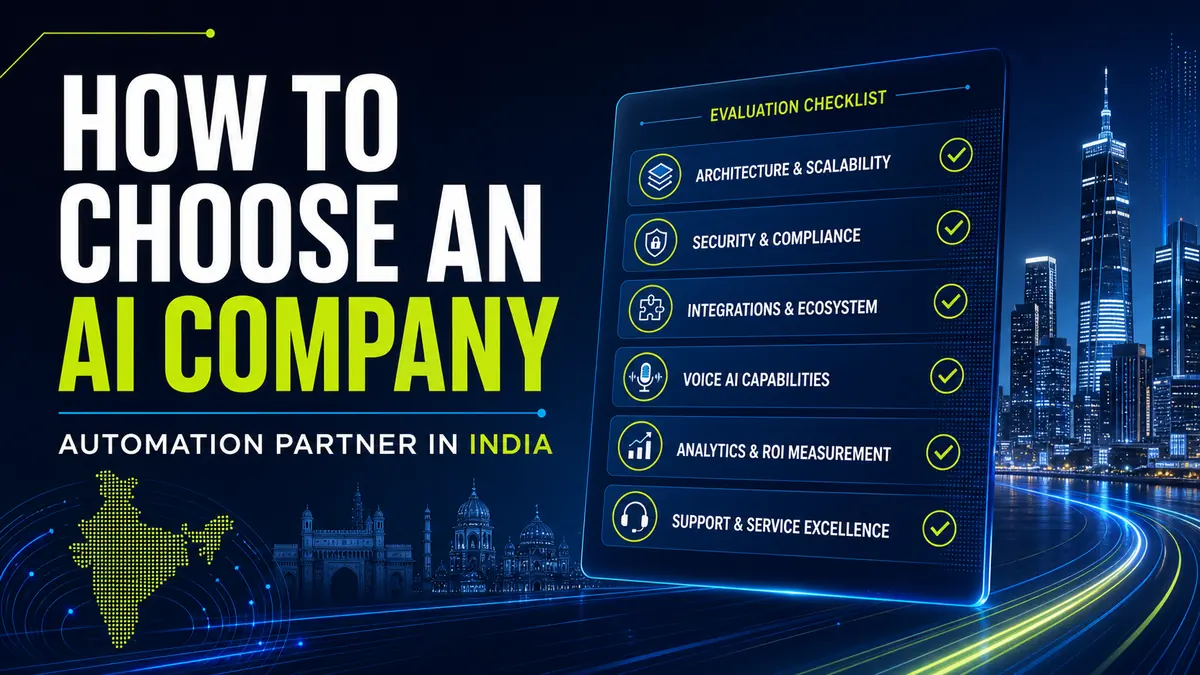
Use this checklist to evaluate the thinking behind the solution: how the company understands your workflow, defines the role of AI, connects to your systems, handles uncertainty, protects data, measures outcomes, and supports the product after launch.
Start with the business problem
A credible partner will ask about the current workflow before recommending a model or platform. They should understand volume, exceptions, data sources, staff roles, customer expectations, and the cost of the problem. If the conversation jumps straight to a generic chatbot, the discovery is incomplete.
Ask the partner to explain what should be automated, what should remain human, what information the system can use, and how success will be measured. This reveals whether the proposed system is grounded in the business or only in a technology trend.
Check production engineering depth
AI automation is a system: interface, backend, database, integrations, prompts, knowledge, telephony or messaging, permissions, logs, monitoring, and support. Review whether the company can design and operate the complete workflow rather than only generate a response in a demo.
For voice agents, ask about interruptions, accents, Hindi and Hinglish, call transfer, recordings, transcripts, retries, phone-number setup, and concurrent calls. For CRM or custom software, ask about roles, audit history, migration, backups, and deployment.
- Clear architecture and integration plan
- Testing with real examples and edge cases
- Human handoff and failure recovery
- Monitoring, logs, alerts, and version control
- Documented ownership and post-launch support
Ask direct questions about security and data
Know what data the system stores, where it is processed, who can access it, how long logs and recordings are retained, and how data is deleted. Customer information should not be copied into tools without a clear purpose, permission model, and retention policy.
The proposal should identify third-party services, secrets management, backups, access controls, and incident handling. The right level of compliance depends on the industry, but every business deserves an understandable explanation of its data flow.
Evaluate the proposal, not only the portfolio
A strong proposal states the problem, scope, assumptions, milestones, acceptance criteria, integrations, metrics, cost model, and exclusions. It separates one-time build work from recurring model, telephony, hosting, and maintenance costs.
Ask for a small pilot with a defined outcome when uncertainty is high. The pilot should include real testing, a review of failure cases, and a decision point for the next phase. Avoid open-ended work where neither the deliverable nor the success condition is clear.
Red flags and a simple scorecard
Be cautious when a provider promises guaranteed rankings, unlimited automation, perfect accuracy, or dramatic savings without understanding your data. Other red flags include unclear ownership, no human fallback, no monitoring plan, copied case studies, and a quote that hides recurring costs.
Score shortlisted partners from one to five on discovery, relevant experience, engineering, integrations, security, communication, local context, support, and commercial clarity. The best partner may not be the cheapest; it should be the one that reduces business risk while creating measurable value.
Frequently Asked Questions
What does an AI automation company do?
It designs and builds systems that use AI with business rules, data, integrations, and interfaces to automate workflows such as lead handling, support, CRM updates, reporting, and voice or messaging interactions.
How do I verify an AI company’s technical ability?
Ask for a workflow-specific demonstration, architecture explanation, integration plan, testing approach, handoff design, monitoring plan, and references or case studies that show production outcomes.
Should an AI automation company provide a pilot?
A focused pilot is useful when the workflow, data, or accuracy is uncertain. It should have a defined scope, real test cases, measurable success criteria, and a clear decision about the next phase.
What should an AI automation proposal include?
It should explain goals, workflow, scope, integrations, data handling, model and telephony assumptions, testing, human fallback, milestones, ownership, recurring costs, support, risks, and exclusions.
Why choose a Jaipur AI automation company for a Rajasthan business?
A Jaipur partner may make local discovery, language, operating context, and in-person collaboration easier. Still, evaluate the company on engineering quality, security, communication, and post-launch support rather than location alone.
Need help turning a repetitive workflow into a reliable system? Talk to Autozentic about AI automation, CRM software, custom software, ecommerce, voice agents, or branding for your business.