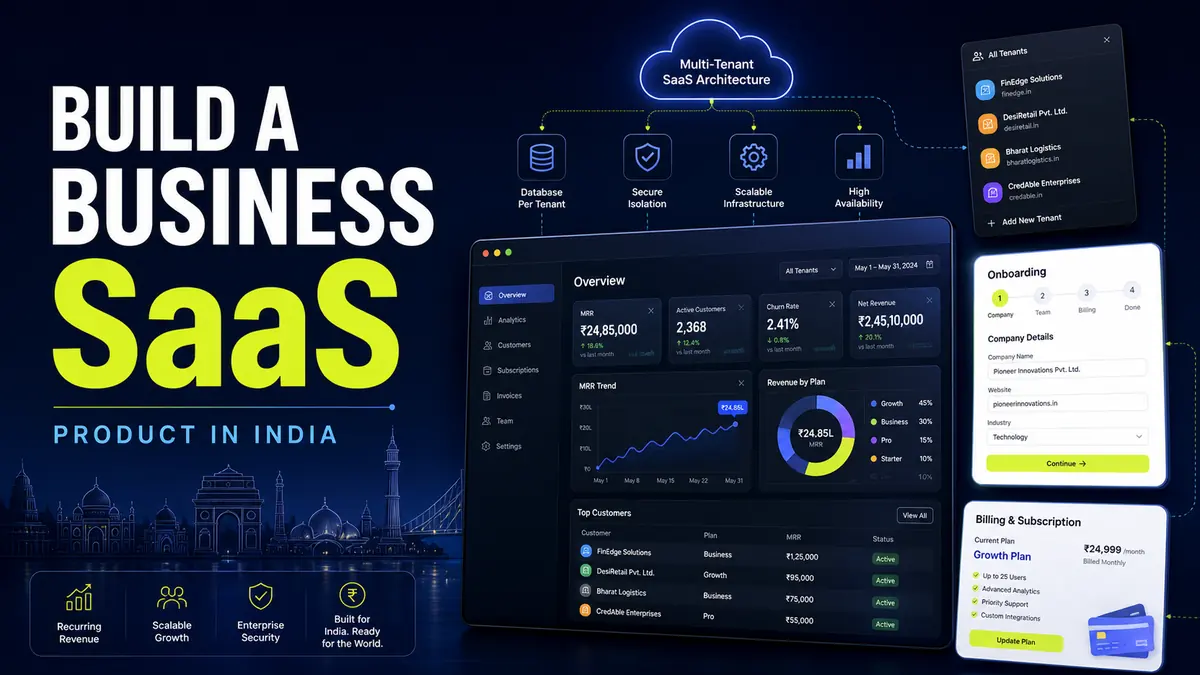
How to Build a Business SaaS Product in India
Building a SaaS product in India requires more than creating a dashboard and putting it online. The product must solve a repeated business problem, support multiple customers safely, make onboarding understandable, and create a path from first use to paid value.
Indian SaaS opportunities often come from operational workflows that are still handled through spreadsheets, calls, WhatsApp, and disconnected tools. The strongest products turn a specific workflow into a repeatable system while respecting local payment, language, compliance, and support expectations.
Start with a narrow customer and problem
Choose a customer segment you can interview and observe. A product for furniture showrooms, clinics, distributors, or agencies can be easier to validate than a vague platform for every business. Document the current workflow, the cost of the problem, the tools already used, and the moment when the customer would pay for improvement.
A good SaaS problem is frequent, painful, and measurable. If the product saves time, increases conversion, reduces errors, or creates visibility, define the baseline before writing the first feature.
Define a useful MVP
The MVP should take a user through the core value loop: sign up or get invited, configure the business, perform the key workflow, and see the result. Keep secondary reporting, edge-case configuration, and broad integrations for later unless they are necessary for the first customer.
For B2B products, include the basics that create trust: roles, audit-friendly activity history, exports, error messages, backups, and support contact. A small but dependable product is easier to learn from than a large product with unfinished paths.
- Clear tenant and user model
- Secure authentication and permissions
- Core workflow with validation and recovery
- Simple onboarding and sample data
- Usage analytics and support feedback loop
Architecture for a multi-tenant product
A SaaS application must keep each customer’s data separated and correctly scoped. Design tenant identifiers, permissions, database queries, file storage, logs, and background jobs with isolation in mind from the beginning. “It is only an MVP” is not a reason to ignore data boundaries.
Plan for configuration without creating an unmaintainable rule system. Use clear domain models, APIs, migrations, automated tests, and observability. Pick infrastructure that the team can operate, not only what looks impressive in a technology diagram.
Billing, onboarding, and support in India
SaaS conversion depends on the first experience. Let a customer understand the product, import or create a small amount of data, and reach a useful outcome quickly. Document the activation event and measure where users stop.
Billing should support the model customers understand, such as monthly or annual plans, seats, usage, or a combination. Account for taxes, invoices, payment failures, refunds, and manual sales-assisted plans. The commercial model should be reflected in permissions and product limits.
Launch, learn, and improve
Launch to a small group of design partners. Watch how they work, review support requests, and measure activation, retention, feature adoption, and value delivered. Founders should be willing to remove features that do not support the core outcome.
A product development partner such as Autozentic can help with discovery, MVP engineering, AI features, integrations, and production operations. The product owner still needs to own customer learning, positioning, pricing, and prioritisation.
Frequently Asked Questions
How much does it cost to build a SaaS product in India?
The range depends on the MVP scope, multi-tenant architecture, integrations, billing, security, design, and operations. A focused MVP may start in the low lakhs, while a production platform with advanced workflows can require a much larger investment.
What is the first step in building a SaaS product?
Interview a narrow customer segment, map the existing workflow, quantify the problem, and define the smallest value loop that a user would adopt and pay for.
Does a SaaS MVP need multi-tenancy from day one?
If multiple customers will use the product, tenant and permission boundaries should be designed from the start. The first version can be simple, but data isolation must be deliberate and tested.
What metrics matter for an early B2B SaaS?
Track activation, time to first value, weekly or monthly usage, retention, support volume, feature adoption, conversion to paid plans, and the measurable business result promised to the customer.
Can AI be added to a SaaS product later?
Yes, but the product should collect and structure the right data first. AI works best when its job, approved knowledge, permissions, feedback loop, and human fallback are clearly defined.
Need help turning a repetitive workflow into a reliable system? Talk to Autozentic about AI automation, CRM software, custom software, ecommerce, voice agents, or branding for your business.