From Idea to Launch: How Autozentic Builds AI Products Like Furzentic
- Home
- From Idea to Launch: How Autozentic Builds AI Products Like Furzentic

Case StudyJUNE 2026
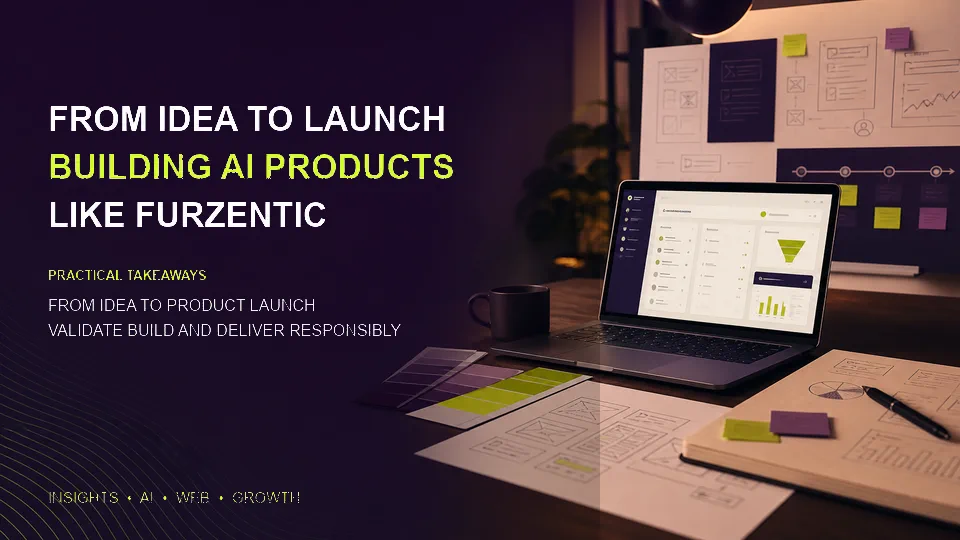
From Idea to Launch: How Autozentic Builds AI Products Like Furzentic
What does it actually look like when an AI company in Jaipur builds a production AI product from scratch? This is the behind-the-scenes story of how Autozentic built Furzentic CRM for furniture businesses — from the initial problem discovery through every major technical and strategic decision to the live product used by furniture showrooms today. And then, how we apply the same process to every custom client project we take on.
Step 1: Identifying the Problem Worth Solving
Furzentic didn't start with a product idea. It started with a pattern we kept seeing across Jaipur's furniture industry: businesses spending significant money on Meta ads, getting hundreds of WhatsApp inquiries, and converting very few of them into actual sales.
The problem wasn't the ads. It wasn't the product. It was the gap between a customer sending "please send sofa price" on WhatsApp and a salesperson actually following up in a way that led somewhere. Leads were piling up unanswered. The ones that did get a response got it hours later, when the customer had already moved on. And nobody had a system for knowing which leads had been followed up, who was interested, and who had gone cold.
This is a real business problem — and it's not unique to one showroom. It's structural to how furniture businesses in Jaipur operate. That's what makes it worth building a product around rather than just a one-off automation workflow. To understand the underlying CRM gap this addresses, read our post on why generic CRMs don't work for furniture retailers.
Step 2: The Technical Architecture Decisions
Once the problem was clear, the technology choices followed from it — not the other way around. This is a principle we apply to every project: technology serves the problem, not the other way around.
LLM Selection
For the AI layer that powers Kia (Furzentic's AI WhatsApp agent), we needed a model that could handle conversational Hindi and Hinglish, understand product queries in natural language, and respond quickly enough to feel like a real conversation. We evaluated multiple frontier models and chose an approach that combines a primary LLM for conversation with a retrieval layer for product-specific information — so Kia always has accurate, up-to-date product knowledge rather than hallucinating catalogue details.
WhatsApp API Integration
Using the official WhatsApp Business API was non-negotiable. Unofficial "scraper" approaches to WhatsApp automation work until they don't — and when they stop working, they take your business number with them. The official API is more complex to set up, requires Meta business verification, and has message template requirements — but it's the only approach that doesn't put your primary business communication channel at risk.
Database and CRM Architecture
Furniture showrooms don't have data teams. The database architecture for Furzentic had to be robust enough to handle complex lead relationships, conversation history, and sales pipeline data — while being maintainable by a small technical team. We made deliberate choices around schema design, indexing, and data structure that allow the system to scale without becoming a maintenance burden.
Step 3: Building Kia — The AI Agent at the Heart of Furzentic
Kia is Furzentic's AI WhatsApp agent — the piece that directly handles customer conversations. Building Kia was not a matter of connecting a chat widget to an LLM API. It required building an agent that could:
- Understand and respond in natural conversational Hindi and English
- Access real product information from the showroom's catalogue
- Qualify leads by asking the right questions without feeling like a form
- Know when to escalate to a human salesperson and do it gracefully
- Log everything into the CRM so no conversation is ever lost
- Handle the full range of customer communication styles — from brief voice note transcriptions to lengthy paragraphs of requirements
Each of these capabilities required separate design and testing. The escalation logic alone went through multiple iterations — getting the threshold right between "let Kia handle it" and "this needs a human" was one of the most important and most challenging parts of the build.
Step 4: Iteration With Real Clients
The version of Furzentic and Kia that exists today is not the version we shipped first. It is the product of sustained iteration with actual furniture business clients who used the system in their daily operations and told us, directly, what wasn't working.
The most valuable feedback rarely came from formal review sessions. It came from watching a salesperson try to use the CRM while simultaneously talking to a customer, or from noticing that Kia was giving technically correct but tonally wrong responses to certain types of inquiries. Real-world usage surfaces problems that no amount of internal testing can anticipate.
This is why we insist on a phased rollout for client projects. A full launch before any real users have touched the system is a mistake we don't make.
Step 5: Lessons Learned That Changed How We Build
Building Furzentic taught us several things that now apply across every client project we take on:
- Prompt engineering is product engineering. The way an AI agent is instructed determines almost everything about its behaviour. We treat prompt design with the same rigour as database schema design or API architecture.
- Human escalation is not a fallback — it's a feature. The best AI systems know their limits. Designing clear, graceful handoff points to human team members is as important as the AI capability itself.
- Adoption requires training, not just deployment. Giving a sales team a new CRM and expecting them to use it is wishful thinking. We now build adoption support — training materials, onboarding sessions, and a 30-day check-in — into every product launch.
- Speed is a product feature. An AI response that takes 10 seconds feels slow in a WhatsApp conversation. Latency optimisation in AI systems is not a nice-to-have; it's a core requirement for user experience.
How This Process Applies to Custom Client Projects
When a Jaipur business comes to Autozentic for a custom AI automation system, we apply the same framework we used to build Furzentic — not because it's the only way, but because it's the way that produces systems that actually work.
We start with problem discovery rather than solution selling. We make technology choices that serve the problem. We build in phases and iterate with real users before scaling. We design human escalation paths, not just AI capabilities. And we stay involved after launch, because the first 30 days of a live AI system are where the most important improvements happen.
This is what separates an AI company in Jaipur that ships real products from one that demos well and disappears. Our production experience — building Furzentic from nothing to a platform used by real furniture businesses — is the context in which every client project lives.
What This Means If You're Considering an AI Project
If you're a Jaipur or Rajasthan business thinking about building an AI system — whether that's a WhatsApp agent, a custom CRM, an automation workflow, or a full AI-powered platform — the most important question to ask any agency you consider is: have you built AI products yourself, and what did you learn?
The answer to that question will tell you more about the quality of the work you'll receive than any sales presentation. We're happy to walk you through our product history and how it informs the way we build. Reach out to the Autozentic team and let's start with the problem you're trying to solve.