Furniture Business CRM Software: Why Generic CRMs Don't Work for Furniture Retailers
- Home
- Furniture Business CRM Software: Why Generic CRMs Don't Work for Furniture Retailers

CRM & ERPJUNE 2026
Furniture Business CRM Software: Why Generic CRMs Don't Work for Furniture Retailers
If you've ever tried to use Salesforce, HubSpot, Zoho, or any other generic CRM for your furniture business, you've probably felt the friction. Fields that don't match your workflow. Terminology designed for B2B SaaS companies, not showrooms. Setup that takes months and still doesn't quite fit. And a monthly bill that's hard to justify when your team still ends up managing half their leads on WhatsApp anyway.
There's a reason for this — and it's not that your team isn't tech-savvy. It's that generic CRMs are not built for the furniture industry.
What Makes Furniture Retail Different from Other Businesses
Furniture sales have a unique set of characteristics that most CRMs completely ignore:
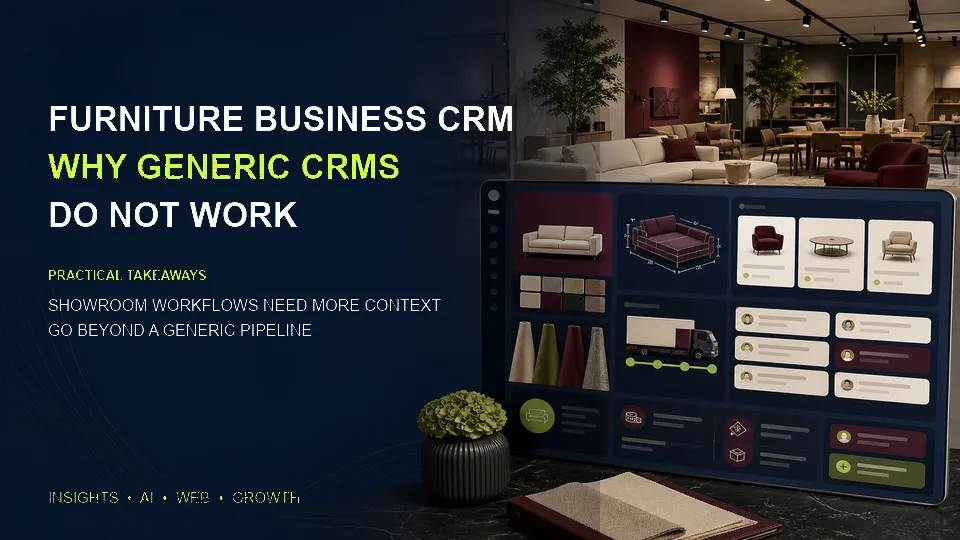
- Visual-first selling: Customers make decisions based on seeing products — images, fabric swatches, colour options. A CRM that can't handle a visual catalogue is useless in furniture sales.
- WhatsApp-first communication: In India, especially in Jaipur, virtually all customer communication happens on WhatsApp — not email. Generic CRMs are built around email-first workflows.
- Long consideration cycles: Furniture purchases are high-value and considered. A customer might inquire, visit the showroom, get a quote, think for two weeks, and then buy. The CRM needs to handle this 2–6 week sales cycle gracefully.
- Custom orders: Many furniture sales involve custom specifications — dimensions, fabric, wood type, colour. A generic CRM has no fields for any of this.
- Delivery and installation tracking: Post-sale, furniture businesses need to track delivery dates, assembly appointments, and customer sign-offs. Generic CRMs end at the sale.
- Seasonal and exhibition sales: Furniture businesses participate in exhibitions, have seasonal peaks, and need to track bulk inquiry days differently from walk-in retail.
Why Salesforce/HubSpot/Zoho Fail Furniture Retailers
1. Setup Requires Months of Customisation
To make a generic CRM work for furniture retail, you need to create custom fields, custom pipelines, custom stages, and custom integrations. This takes months, requires either an expensive consultant or a technical team member, and still results in a system that's "almost right" rather than purpose-built.
2. WhatsApp Integration Is an Afterthought
Most enterprise CRMs offer WhatsApp as a paid add-on or through a third-party integration that's clunky and unreliable. For Indian furniture businesses where WhatsApp IS the sales channel, this is a critical failure.
3. They're Priced for Enterprise, Not SMEs
Salesforce starts at ₹1,500/user/month on paper — but the full product with WhatsApp, automations, and reporting easily reaches ₹5,000–₹10,000/user/month. For a 3-person team, that's ₹15,000–₹30,000/month on software alone.
4. Your Team Won't Use It
The final and most common failure: a complex CRM that's been expensively set up but doesn't match the team's actual workflow. Staff revert to WhatsApp and Excel. The CRM data becomes stale. The investment is wasted.
What Furniture Businesses Actually Need in a CRM
- WhatsApp-native lead capture and communication
- Visual product catalogue linked to customer inquiries
- Custom order specifications (dimensions, materials, colours)
- Delivery and installation tracking
- Simple pipeline: Inquiry → Quote Sent → Follow-up → Order Confirmed → In Production → Delivered
- Automated follow-up reminders
- Multi-branch support for showrooms in different locations
- Priced reasonably for Indian SMEs
Furzentic: CRM Built for Furniture Businesses
This is exactly why Autozentic built Furzentic — a CRM and ERP platform designed from the ground up for furniture retailers and manufacturers in India. It handles WhatsApp natively (with Kia, our AI WhatsApp agent), connects directly to your product catalogue, tracks custom orders, and gives you a sales pipeline that matches how furniture actually gets sold.
If you've been frustrated by generic CRMs, talk to us about Furzentic — we'll show you what a purpose-built furniture CRM actually looks like.