Custom CRM vs Salesforce vs HubSpot for Indian SMEs
Choosing a CRM is a business design decision, not only a software purchase. The right platform should match the sales process, team size, data discipline, reporting needs, integrations, and budget of the business.
Salesforce and HubSpot offer mature ecosystems and fast access to standard CRM capabilities. A custom CRM offers deeper control over workflows and data, but it requires thoughtful product design and long-term ownership. This guide helps Indian SMEs compare the options on the dimensions that matter in practice.
When an off-the-shelf CRM is the right choice
A packaged CRM is a strong fit when the business can follow a standard lead and opportunity process, needs a proven interface quickly, and values a large integration ecosystem. It can be easier to hire trained users and connect common marketing, email, reporting, and support tools.
The trade-off is that the team may need to adapt its process to the platform. Subscription tiers, add-ons, implementation partners, data limits, and automation rules should be reviewed before the business treats the headline plan price as the total cost.
When a custom CRM makes sense
A custom CRM is useful when the workflow is a competitive advantage or does not fit a generic pipeline. Examples include furniture configuration and quotations, industry-specific approvals, field operations, regional language requirements, or a close connection between lead, production, and delivery.
Custom does not mean building every feature from scratch. The best approach is to define the smallest workflow that creates value, use reliable services for commodity capabilities, and own the business rules and data model that make the product special.
- Custom stages, forms, roles, and approval logic
- Industry-specific quotation or order workflows
- Direct integration with internal software and databases
- Control over data model, interface, roadmap, and hosting choices
A practical comparison
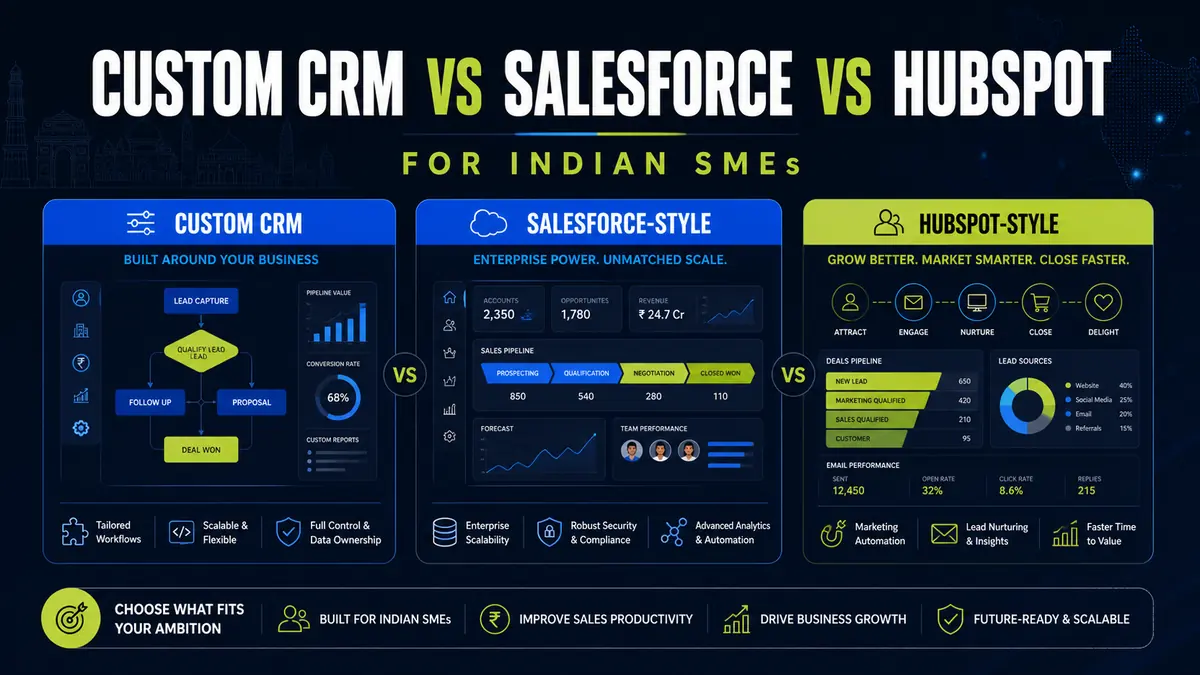
Salesforce is often selected by teams that need deep configurability, enterprise governance, and a broad ecosystem. HubSpot is attractive to businesses that want marketing, sales, and service capabilities in a comparatively approachable system. A custom CRM is attractive when the business needs a focused product built around its own workflow and is prepared to own the product roadmap.
Compare the options using the same questions: Can the platform model the real sales process? Can it integrate with the systems that hold truth? Can the team afford the total cost for three years? Can staff adopt it? Can the business export and govern its data?
Total cost of ownership for an Indian SME
Calculate licences, implementation, customisation, migration, training, integrations, support, user growth, and the cost of workarounds. A low subscription can still be expensive if staff must copy data between tools. A custom build can be economical when it replaces several disconnected processes, but only if scope and maintenance are controlled.
Do not compare a custom build only with the first-year subscription. Compare the expected workflow, ownership, flexibility, and support over the time horizon that matters to the business. Include security updates, backups, monitoring, and future changes in the custom product plan.
A decision checklist
Choose a packaged CRM when speed, standardisation, and ecosystem access are the priority. Choose custom when the process is distinctive, integrations are central, and the business needs ownership of the experience. A hybrid approach can work too: use an established CRM for standard records and build a focused application for the unique workflow.
Before signing, run a process workshop with sales, operations, and management. Ask each provider to demonstrate the exact journey from enquiry to closed deal using your terminology and data. Autozentic can help Indian SMEs evaluate or build CRM software around the workflows they actually run.
Frequently Asked Questions
Is a custom CRM better than Salesforce for an Indian SME?
Not automatically. Salesforce is strong for configurable, mature CRM operations, while a custom CRM can fit a distinctive workflow better. The decision depends on process complexity, budget, integrations, internal ownership, and long-term roadmap.
Is HubSpot suitable for small businesses in India?
It can be suitable when the business wants standard marketing, sales, and service workflows with an established ecosystem. Review plan limits, add-ons, implementation, data migration, and future user growth before deciding.
What is the biggest risk of building a custom CRM?
The main risk is unclear scope and weak ownership after launch. A focused first version, documented requirements, testing, backups, security updates, and a maintenance plan reduce that risk.
Can a custom CRM integrate with HubSpot or Salesforce?
Yes. A custom application can connect through supported APIs and webhooks. The design should clearly define which system owns customer, opportunity, activity, and reporting data.
How should an SME compare CRM costs?
Compare three-year total cost of ownership, including licences, implementation, migration, integrations, training, support, customisation, internal workarounds, and future growth—not just the monthly plan.
Need help turning a repetitive workflow into a reliable system? Talk to Autozentic about AI automation, CRM software, custom software, ecommerce, voice agents, or branding for your business.