CRM Software for Furniture Showrooms: The Complete Guide
Furniture sales rarely finish in a single interaction. A customer may visit a showroom, compare materials, request a quotation, share room measurements on WhatsApp, discuss delivery, and return weeks later. If these details live in notebooks and personal phones, the business loses context and sales follow-up becomes inconsistent.
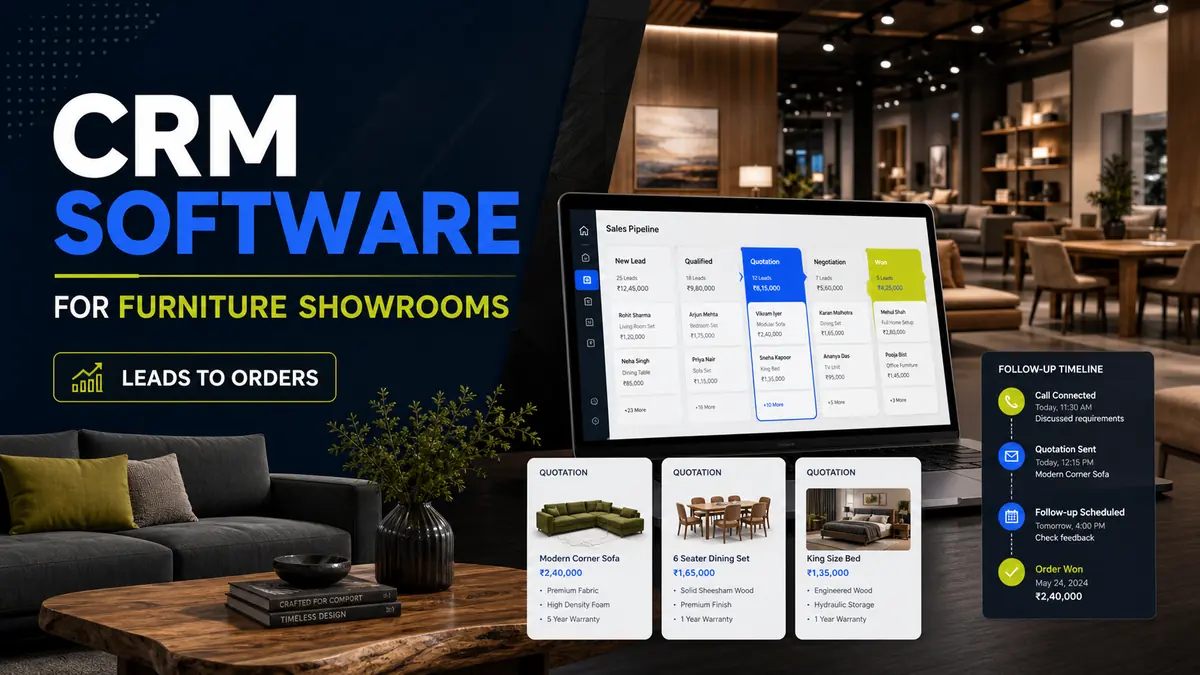
CRM software for furniture showrooms should reflect the way furniture is actually sold. It needs to connect enquiries, people, products, quotations, follow-ups, delivery expectations, and post-sale communication without forcing the sales team to work around a generic pipeline.
The showroom lead journey
A useful furniture CRM starts at the first touchpoint: walk-in, website form, phone call, social media, marketplace, or WhatsApp. The record should capture the customer requirement, room or project type, preferred style, budget range, location, purchase timeline, and the salesperson responsible.
The lead then moves through stages such as new enquiry, consultation, product shortlist, measurement, quotation, negotiation, booking, delivery, and after-sales. Each stage should have a next action and an owner. A pipeline is valuable only when it tells the team what must happen next.
Features a furniture CRM should include
Furniture teams need more than contact storage. They need product and quotation context, configurable options, customer communication history, reminders, and visibility into pending decisions. The system should make it easy to see why a lead has not moved and what information is still missing.
The following capabilities are a practical baseline for a showroom or furniture brand:
- Lead capture from website, calls, WhatsApp, campaigns, and showroom visits
- Customer profiles with room, style, budget, location, and project notes
- Quotation creation with products, variants, discounts, taxes, and validity
- Task reminders for callbacks, measurements, approvals, and delivery updates
- Role-based access for owners, managers, salespeople, and support staff
- Reports for source, stage ageing, conversion, average order value, and lost reasons
WhatsApp, calls, and quotation follow-up
Furniture customers often send images, dimensions, inspiration, and voice notes on WhatsApp. A CRM should preserve the important context and link it to the right customer record. Automation can remind a salesperson when a quotation has not received a response, but it should respect customer preferences and avoid spam.
Call notes and recordings should follow a clear retention and access policy. If an AI assistant is used for first-contact qualification, it should create a structured summary rather than dumping an unsearchable transcript into the CRM.
CRM versus inventory and ERP
A CRM manages relationships, opportunities, conversations, and follow-up. Inventory and ERP systems manage stock, purchasing, production, accounting, and fulfilment. A furniture business may need both. The CRM should not pretend to replace every operational system if the real requirement is a reliable connection between sales and fulfilment.
The integration should define which system owns product availability, pricing, tax, order status, and delivery information. When the systems agree on identifiers and permissions, the salesperson can give the customer a more accurate answer without manually checking several tools.
How to measure showroom CRM success
Track response time, lead-to-consultation rate, quotation-to-order conversion, follow-up completion, stage ageing, lost reasons, repeat enquiries, and sales by source. Managers should be able to see whether a campaign creates qualified conversations, not only raw leads.
Implementation should be phased. Start with a clean pipeline and reliable customer record, then add quotation workflows, integrations, WhatsApp processes, and AI assistance. Furzentic is Autozentic’s furniture-focused CRM initiative, while the same discovery principles apply to custom CRM projects for other industries.
Frequently Asked Questions
What is CRM software for a furniture showroom?
It is software that organises showroom enquiries, customer requirements, product discussions, quotations, follow-ups, orders, delivery communication, and after-sales relationships in one workflow.
Can a furniture CRM manage WhatsApp leads?
It can capture or connect WhatsApp enquiries, attach important messages or summaries to the customer record, assign an owner, and create follow-up tasks. The exact setup depends on the WhatsApp integration and business process.
Should a furniture business use a CRM or an ERP?
Many furniture businesses need both. A CRM manages leads and relationships, while an ERP or inventory system manages stock, production, accounting, and fulfilment. Integrating them avoids duplicate manual work.
Can a CRM generate furniture quotations?
Yes, a suitable CRM can generate quotations with products, variants, pricing, discounts, taxes, validity, and approval rules. It should connect to the authoritative product and pricing data.
How long does furniture CRM implementation take?
A basic pipeline can be launched quickly, while quotation, WhatsApp, inventory, permissions, reporting, and migration make the project longer. A phased rollout reduces risk and helps the team adopt the system.
Need help turning a repetitive workflow into a reliable system? Talk to Autozentic about AI automation, CRM software, custom software, ecommerce, voice agents, or branding for your business.