Top Business Automation Trends in Rajasthan for 2026
- Home
- Top Business Automation Trends in Rajasthan for 2026

Business AutomationJUNE 2026
Top Business Automation Trends in Rajasthan for 2026
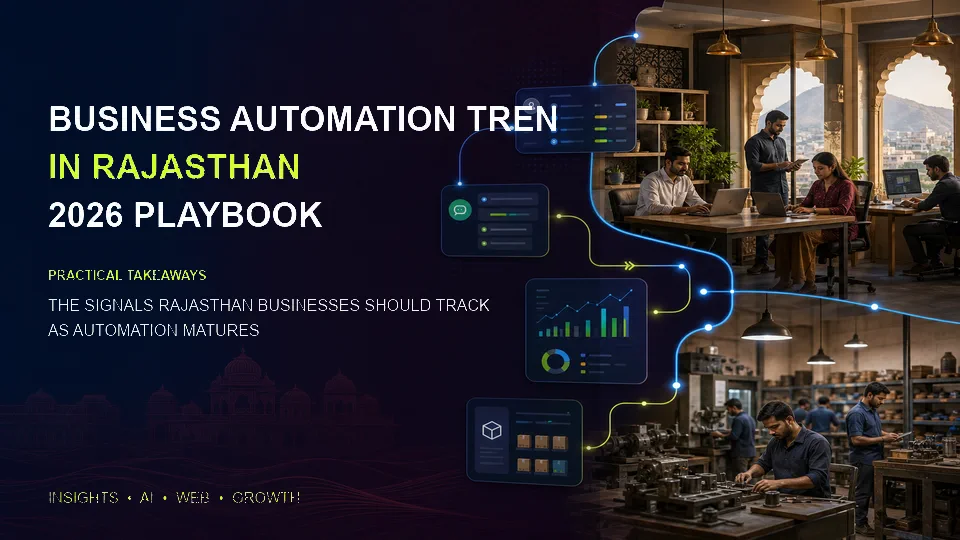
Rajasthan's business landscape is shifting faster than most people outside the state realise. From Jaipur's furniture corridors to Jodhpur's textile exporters and Udaipur's hospitality businesses, automation is no longer a future conversation — it's a live operational decision. These are the eight business automation trends in Rajasthan that are reshaping how local businesses work in 2026, and what each one means in practice.
1. WhatsApp-First AI Agents Are Becoming the Default Customer Interface
Rajasthan's business communication is overwhelmingly WhatsApp-native. Customers send product queries on WhatsApp, sales teams follow up on WhatsApp, and orders are often confirmed there too. In 2026, the businesses pulling ahead aren't the ones that have moved away from WhatsApp — they're the ones that have put AI on top of it.
WhatsApp AI agents built on the official Business API can now handle inbound inquiries, send catalogues, answer pricing questions, collect customer details, and qualify leads — all without a human in the loop for routine conversations. Furniture showrooms in Mansarovar, real estate developers in Vaishali Nagar, and garment exporters across Jaipur are implementing these systems and seeing first-response times drop from hours to seconds.
Our AI automation services in Rajasthan include WhatsApp AI agent development built specifically for these customer communication patterns.
2. Agentic AI Is Replacing Simple Rule-Based Bots
The chatbots of 2020-2023 were rule-based decision trees. If a customer said something unexpected, the bot fell apart. In 2026, Rajasthan's more sophisticated businesses are replacing these with agentic AI systems — AI that understands context, makes decisions across multiple steps, and handles conversations that don't follow a script.
An agentic AI can receive a customer query on WhatsApp, look up their order history in the CRM, check stock availability in the inventory system, generate a personalised response, and escalate to a human only if the situation is genuinely complex. This isn't theoretical — it's running in live Jaipur businesses today. The shift from rule-based to agentic automation is one of the most important transitions happening in Rajasthan's SME sector right now.
3. CRM Adoption Is Surging in Furniture and Textile Businesses
Two industries define Jaipur's commercial identity: furniture and textiles. Both have historically managed customer relationships through notebooks, Excel sheets, and the memory of experienced salespeople. That's changing rapidly in 2026.
CRM adoption in these sectors is being driven by a simple realisation: leads are being lost at scale. A furniture showroom might get 200 WhatsApp inquiries a week. Without a CRM, tracking who's been followed up, what they were shown, where they are in the buying cycle, and when to reach out again is impossible. CRMs designed specifically for these industries — rather than generic tools built for Western SaaS companies — are gaining ground fast.
Platforms like Furzentic, built by Autozentic specifically for furniture businesses, represent the kind of industry-specific CRM that's driving this trend: WhatsApp-integrated, mobile-first, and designed around the actual sales workflow of a Jaipur showroom.
4. n8n Is Winning the Workflow Automation Race Against Zapier for Indian SMEs
Zapier and Make.com have dominated the global workflow automation market for years. But in 2026, Rajasthan's tech-forward businesses are increasingly choosing n8n as their workflow automation platform — and for good reason. n8n is self-hostable, which means no per-execution pricing that scales to painful levels as automation volume grows. For an Indian SME running thousands of automated workflows a month, the cost difference is significant.
n8n also integrates more cleanly with Indian platforms — payment gateways like Razorpay, Indian ERP systems, and regional CRM tools that Zapier either doesn't support or supports poorly. If you're evaluating automation platforms, read our detailed n8n vs Zapier vs Make comparison for Indian businesses before making a decision.
5. AI Voice Agents for Missed Call Follow-Up
Missed calls are one of Rajasthan's most significant hidden business problems. A showroom sales team gets busy with in-person customers. A phone rings, nobody picks up, and that lead — who may have driven across the city to visit after seeing an ad — calls a competitor instead. In 2026, AI voice agents are being used to close this gap.
When a call is missed, an AI voice agent can automatically call back within minutes, introduce itself (as an assistant for the business), answer basic queries about products and pricing in Hindi, collect the customer's interest details, and book a callback with the sales team. For businesses spending on Meta ads to generate inbound calls, the ROI of not losing those calls is immediate and measurable.
6. Meta Ads + CRM Integration Is Becoming Standard for Lead-Driven Businesses
Most Rajasthan businesses running Facebook and Instagram ads are still doing it the slow way: a lead comes in, Meta sends a notification, someone manually copies the lead into a spreadsheet, and the follow-up happens whenever a salesperson gets to it — which is often hours later. In 2026, this manual handoff is being replaced by direct Meta Lead Ads to CRM integration.
When a lead submits a form on Instagram, the data flows instantly into the CRM, triggers a WhatsApp message from the AI agent, assigns the lead to the relevant salesperson, and starts the follow-up sequence automatically. The businesses in Jaipur that have implemented this are reporting dramatically higher lead conversion rates — because speed of first contact matters enormously in the buying decisions of furniture and home goods customers.
7. Multilingual AI Chatbots for Hindi-Speaking Customers
The assumption that business automation should work in English is a mistake that trips up businesses and agencies alike. A significant portion of Rajasthan's customer base communicates in Hindi — and for many, Hindi is the language in which they feel comfortable asking detailed questions, expressing concerns, and ultimately making buying decisions.
In 2026, AI chatbots and WhatsApp agents capable of understanding and responding naturally in Hindi are becoming a competitive advantage in Rajasthan's consumer-facing businesses. This includes not just text Hindi but Hinglish — the natural code-switching that characterises most WhatsApp conversations. Businesses that deploy English-only bots and then wonder why customers don't engage with them are missing something obvious.
8. No-Code ERP Adoption Is Accelerating Among Mid-Sized Businesses
Traditional ERP systems — SAP, Oracle, even Tally for basic accounting — have long been the domain of larger businesses willing to invest in implementation and training. In 2026, a new generation of no-code and low-code ERP tools is changing this calculus for Rajasthan's mid-sized businesses.
A furniture manufacturer with 20-50 employees can now implement production tracking, inventory management, order processing, and invoicing automation without a six-figure ERP implementation. These systems connect directly to their WhatsApp workflows and CRM, creating an integrated operational picture that was previously impossible at this price point. The appetite for this kind of integrated business software among Jaipur's manufacturers and exporters is significant and growing.
What These Trends Mean for Your Business
The common thread across all eight of these trends is integration. The businesses winning in Rajasthan in 2026 aren't using automation in isolation — they're connecting their WhatsApp communication, their CRM data, their ad spend, and their operations into a coherent system where information flows automatically and humans focus on decisions, not data entry.
If your business is still running on disconnected tools and manual handoffs, the gap between you and your most automated competitor is widening. The good news is that the cost of entry for meaningful business automation has fallen significantly — you don't need a large budget to make a significant impact on your response times and operational efficiency.
To explore what automation could look like for your specific business, talk to the Autozentic team. We work with Rajasthan businesses across furniture, textiles, real estate, and professional services to design automation systems that fit the way those businesses actually work.