Web DevelopmentJUNE 2026
Shopify vs WordPress vs Custom Development: Which Is Right for Your Jaipur Business?
When a Jaipur business decides to build or rebuild a website, one of the first decisions they face is platform choice: Shopify, WordPress, or custom development. The answer is not always obvious, and making the wrong choice costs money — either in building the wrong thing or in rebuilding it later when you hit its limits. This guide gives you an honest, practical breakdown from a Shopify development company in Jaipur that has worked with all three platforms.
The Three Options at a Glance
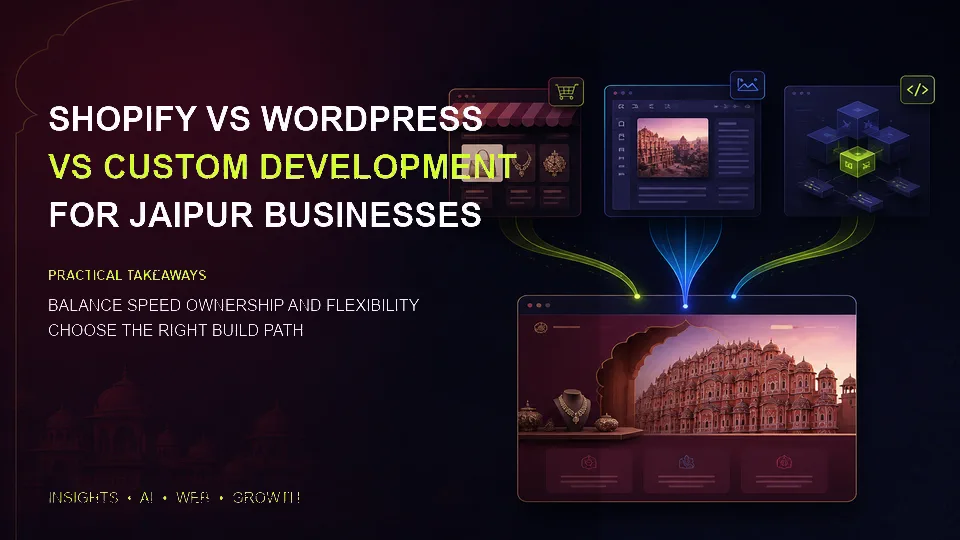
Before diving into detail, here is a high-level summary of where each platform excels:
- Shopify: Best for product-focused e-commerce businesses that want speed to market, reliable hosting, and a large app ecosystem — without managing servers.
- WordPress: Best for content-heavy businesses, blogs, local service sites, and businesses that want flexible design control with a familiar CMS.
- Custom Development: Best for businesses with unique workflows, complex integrations, or specific performance and design requirements that no off-the-shelf platform can handle.
Shopify: The Case For and Against
Why Shopify Works Well
Shopify is purpose-built for e-commerce. It handles hosting, security, and platform updates automatically, which means your team focuses on selling rather than managing infrastructure. The checkout experience is polished and conversion-optimised by default. Shopify Payments (and Razorpay integration in India) makes accepting online orders straightforward.
For a Jaipur furniture brand or home decor label launching an online store, Shopify can get you from zero to a fully functional product catalogue and checkout in a matter of days rather than weeks. As a Shopify development company in Jaipur, Autozentic has built Shopify stores including work for Kosmic Furniture — where the priority was launching a visually compelling product showcase with a smooth buying journey quickly.
Shopify Limitations to Know
- Monthly subscription cost: Shopify plans start at around ₹1,500–₹2,000/month and go significantly higher for advanced features. Over three to five years, this adds up.
- Transaction fees: Unless you use Shopify Payments (not available in India), every transaction has a fee on top of your payment gateway fees.
- Limited flexibility outside e-commerce: Shopify is excellent at selling products, but if you need complex non-commerce functionality, you will hit its limits.
- Content marketing is secondary: Shopify's blogging and SEO capabilities are functional but not as strong as WordPress for content-driven traffic strategies.
Best for Jaipur businesses: Furniture showrooms, handicraft exporters, clothing brands, and any retail business with a clear product catalogue.
WordPress: The Case For and Against
Why WordPress Works Well
WordPress powers around 43% of the web for good reason. It is highly flexible, has an enormous plugin ecosystem, and gives you full control over your hosting environment. For content-driven businesses — companies that blog, publish case studies, or maintain a knowledge base — WordPress remains the most powerful platform.
WooCommerce (WordPress's e-commerce layer) is also a strong option for businesses that want e-commerce but need more content and SEO flexibility than Shopify provides. It is particularly popular with businesses that have complex product variations or need custom pricing rules.
WordPress Limitations to Know
- Security maintenance: WordPress sites require regular plugin updates and security monitoring. Neglected WordPress sites are among the most commonly hacked websites in India.
- Performance requires work: Out of the box, WordPress can be slow. Achieving fast load times requires caching, CDN setup, and image optimisation — all of which add complexity.
- Plugin conflicts: Relying heavily on plugins from different developers creates compatibility issues that can break site functionality.
- Technical debt: Many Jaipur businesses end up with WordPress sites that no developer wants to touch because of years of accumulated plugin mess.
Best for Jaipur businesses: Consultancies, law firms, service businesses, local service companies, and businesses where content and SEO are central to their strategy.
Custom Development: The Case For and Against
Why Custom Development Works Well
Custom development — building your site or application from the ground up using a modern framework like Next.js, React, or similar — is the most powerful option when you have specific requirements. You get exactly what you need: your design, your logic, your integrations, optimised exactly for your use case.
Custom-built sites are typically faster than WordPress (when properly built), more secure (no third-party plugins to exploit), and infinitely more flexible. At Autozentic, we build most of our client web projects on Next.js — which delivers excellent Core Web Vitals scores, superb SEO performance, and is well-suited for integrating AI automation features like chatbots, lead capture agents, and dynamic content.
The Autozentic website itself is a custom Next.js build. Our product Furzentic — a full CRM and ERP platform for furniture businesses — was built entirely custom because no existing platform could handle the specific operational workflows furniture manufacturers need.
Custom Development Limitations to Know
- Higher upfront cost: Custom development takes longer and costs more than a Shopify theme or WordPress template. You are paying for craftsmanship, not commodity work.
- Developer dependency: All future changes require a developer who understands the codebase. This is less of an issue when you have a long-term partner like Autozentic, but it is a consideration.
- Longer build time: A custom site takes weeks rather than days. If you need something live in 48 hours, custom is not the right choice.
Best for Jaipur businesses: High-end brands where design quality matters, companies with unique business logic, businesses that want to integrate AI automation, and SaaS or platform products.
Side-by-Side Comparison
| Factor | Shopify | WordPress | Custom |
|---|---|---|---|
| Speed to launch | Fast | Medium | Slower |
| Upfront cost | Medium | Low–Medium | Higher |
| Ongoing costs | Monthly sub | Hosting + plugins | Hosting only |
| SEO capability | Good | Very good | Excellent |
| Design flexibility | Moderate | Good | Unlimited |
| Security | Managed | Your responsibility | Your responsibility |
| AI integration | Via apps | Via plugins | Native, unlimited |
When to Go Shopify: Autozentic's Work with Kosmic Furniture
Kosmic Furniture needed to launch an online storefront that could showcase their furniture catalogue professionally and take orders online. The brief required speed, visual impact, and a reliable e-commerce infrastructure. We chose Shopify because it provided the fastest path to a fully functional, polished online store without compromising on the product browsing experience.
As a Shopify development company in Jaipur, we customised the theme deeply, built custom product filters, and integrated the store with WhatsApp for order updates and customer queries. The result was a live, selling store in a fraction of the time a custom build would have taken.
When to Go Custom: The Furzentic Example
Furzentic, Autozentic's own product for the furniture industry, required a custom build from day one. No Shopify app or WordPress plugin could handle the combination of CRM, ERP, lead pipeline management, and AI-powered communication tools that furniture manufacturers need. Custom development was the only path.
If your business has operational workflows that existing platforms cannot accommodate, custom is almost always the right investment.
The Honest Answer
There is no universally right answer. A Jaipur retailer launching their first online store should probably start with Shopify. A local consultancy wanting an informational website with strong SEO should look at WordPress or a custom Next.js build. A business with unique operational needs should invest in custom development.
What we recommend: do not let platform familiarity drive the decision. Let your business goals drive it.
Autozentic works across all three and will always recommend what is genuinely right for your situation — not what is easiest for us to build. Talk to Autozentic about your project and we will give you an honest platform recommendation with no agenda. You can also explore our web solutions to understand the full range of what we build.